B2E · IT Portal · Web
Digital Platforms Portal
Centralize documentation and provide automated self-service for cloud autonomy
Client
TotalEnergies
Scope
Revamp
Technology
Drupal + React
Year
2025 - present

Measured impacts
-
Boosted NPS from 7 to 57 in just one year, while active users doubled.
-
Enhanced speed performance and ensured full platform accessibility.
-
Raised mandatory completion rates by 25% via UX enhancements.
My results
-
I established a dual qual-quant feedback loop for continuous discovery & optimization.
-
I enforced web accessibility compliance.
-
I spearheaded the Design System migration & established shared components to scale cross-platform consistency.
-
I structured Ops with Product Leadership to unify team standards and workflows.
Highlights
Context
The starting point
To support TotalEnergies’ digital acceleration, a Drupal-based platform was introduced to replace legacy manual procedures (emails, Teams chats). It provides a back-office where contributing IT squads can manage their services and publish API-driven, self-service forms to deploy, manage and optimize costs of their digital applications.
Product goal
A centralized portal combining AI support, automated workflows, actionable reporting, and FinOps cost optimization, empowering TotalEnergies IT squads with self-service Cloud autonomy and faster deployment of applications of end-users.
My objectives
By joining the team 3 years after the initial launch, my mission was to elevate the product to match growing enterprise demand:
-
Streamlining & Performance: Removed obsolete content, deleted redundant pages, and optimized existing or created flows to reduce operational friction.
Case study: Onboarding
-
Scalable experience: Enhanced usability for both IT squads managing their products & self-service catalog and end-users provisioning cloud resources.
Case study: Menu
-
UI & Design System migration: I led the transition of the platform from the legacy enterprise UI to the new Design System established by Design Studio for visual, functional consistency and accessibility. I created some specified components to comply with Portal features.
Case study: DesignOps
About the governance
My stakeholders ecosystem
Inside my core team composed by a Product Owner, Tech lead, 3 Drupal developers, React developer and a DevOps, together we do in order to implement the DP Portal product. By following agility method, we divided year into quarter to deliver features: improvements from DP Squads, evolutions from Head of Product or continuous improvement from end-users.
Then, as a UX Coach of DP Department, I have the responsibility of the consistency of the Department user experience throughout other products with have a custom front-end platform like API, IoT, Data team.
I have also, some rituals with Design Studio, part of TotalEnergies Digital Factory to keep an eye of standards.
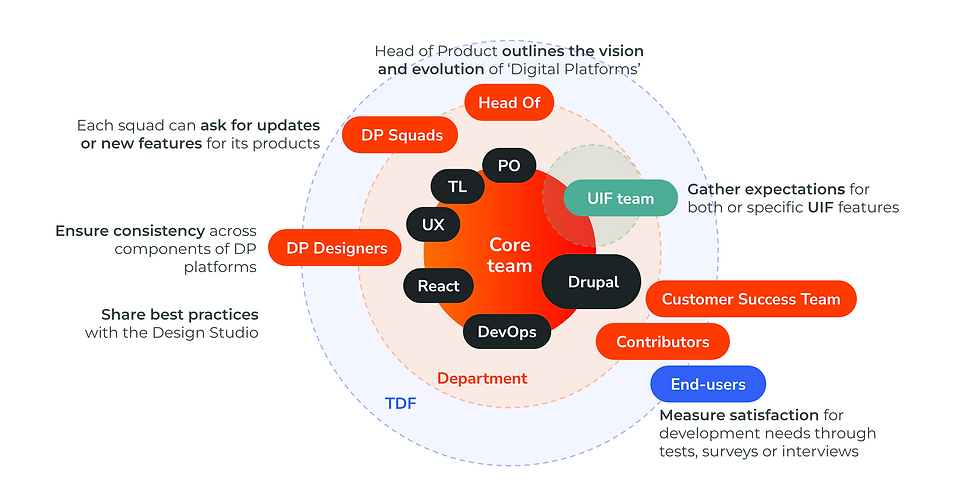
↪ Stakeholder map
Graphism work

↪ Previous illustrations

↪ New illutrations generated with AI
Case study: Menu navigation
Statement
Overhaul Portal Navigation to streamline discovery and user efficiency
Features concerned
Self-services · Quick access
Method
My approach combined internal research and industry benchmarking: I audited existing content and gathered historical user insights from core team members, while benchmarking leading IT platforms (AWS, Microsoft, Red Hat) to design an intuitive mega-menu navigation.

↪ Previous menu to revamp
My challenge
Beyond a visual UI refresh, the goal was to streamline functional complexity and bring clarity to a dense ecosystem of services:
Key features were designed around three core objectives:
-
Cognitive Load: How might we guide users efficiently without overloading the navigation?
-
Information Architecture: How should we structure categories (Products & related services)?
-
Personalization: How can we tailor content dynamically based on user roles?

↪ Menu revamped
What I have learned
As my initial contribution to this flagship product, this feature enabled me to set my design standards and build strong alignment with the engineering team.
6000
active users
in 2026
+1500
new users
from January 2026
7750
self-services
requested in 2025
Case study: DesignOps
Goal
Facilitate the product team’s information gathering and ensure that the context of the work is taken into account for an artificial intelligence implementation
Topics concerned
Design & product documentation
Objective
Established recurring DesignOps syncs with the Head of Product to align on cross-functional initiatives and anticipate roadmap changes.
This initiative may enforce consistent design standards across all squads, elevating overall UX maturity and driving long-term user satisfaction.


↪ Standardizing user flows through a single matrix
What I have learned
An open leadership model unlocks true DesignOps value. By challenging product strategy alongside an accessible Head of Product, I brought critical UX perspective while proposing a multi-project squad model.
Moving designers out of functional silos fostered cross-collaboration, unified user journeys, and raised quality standards across teams.